Why Every Undergraduate Should Consider a Minor (if not Major) in Economics
These are only my thoughts on why I tell students to consider economics, as a minor or a major.
Earnings
Waldron (2024) ranks college fields by synthetic work-life earnings. Synthetic work-life earnings means a constructed lifetime total for full-time workers ages 25-64, not one year’s paycheck. Economics sits at the top of that ranking.
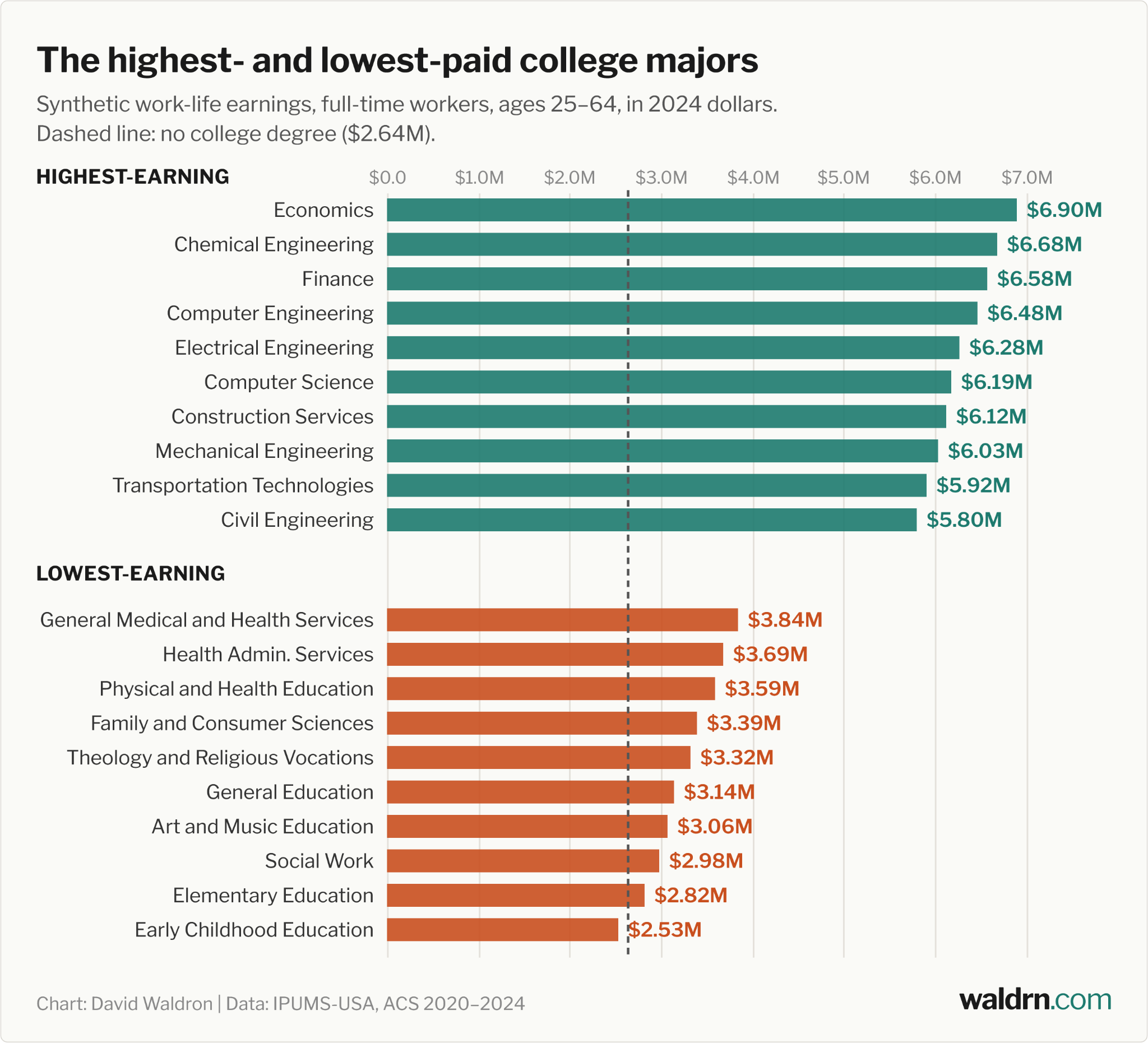
Highest- and lowest-paid college majors, synthetic work-life earnings for full-time workers ages 25-64 (2024 dollars). Source: Waldron (2024).
The rank compares people who already majored in economics with people who majored in a different field. Those groups differ in preparation, hours, industry, and the other work they could have done. It is not the effect of the courses.
The next figure is income by major from the 2024 American Community Survey. One panel plots mean income against skewness. Higher-mean majors sit lower on skew, and economics sits with them. The other panel plots mean income against the standard deviation. Economics is a high-mean major, and its spread is among the widest.
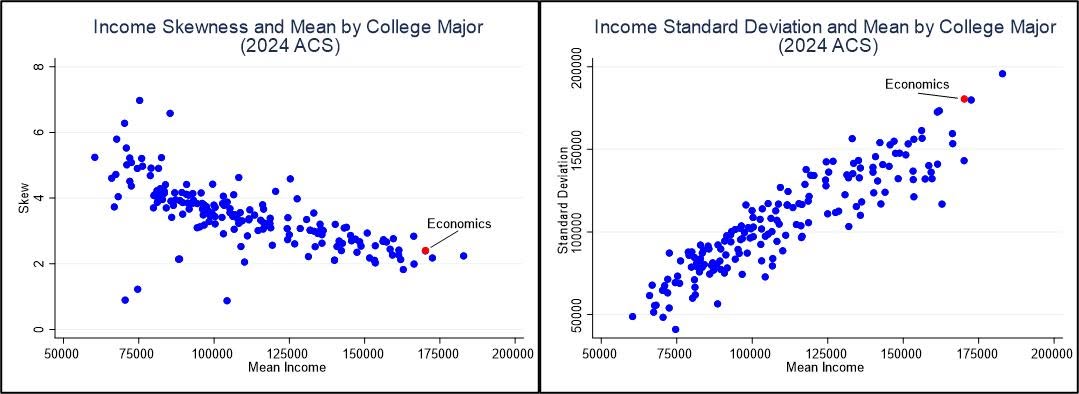
Income by college major from the 2024 American Community Survey, with economics highlighted. Source: Income by major, ACS 2024.
The Federal Reserve Bank of New York reports wages by college field from the ACS. In the 2024 table, people who studied economics and whose highest degree is a bachelor’s have a median wage of $72,000 early in the career (ages 22-27) and $115,000 in mid-career (ages 35-45). The mid-career median ranks ninth among fields, just above finance.
Source: Federal Reserve Bank of New York, The Labor Market for Recent College Graduates
Waldron’s top rank and the New York Fed’s ninth-place median can both be true. One is a lifetime total for full-time workers ages 25-64. The other is a median wage for bachelor’s holders in one age band. Ages 22-27 and ages 35-45 are different people in the same survey year. They are not one group of graduates getting raises. The wide spread in the survey figure is why a high mean, and a lifetime total built from full-time work, need not line up with that median.
What a minor changes
Every number above follows the major. A minor does not appear in those rankings. In the minor I would have students practice opportunity cost, meaning what you give up, and marginal change, meaning the next unit, not the average. The price is the credits. They could have been another minor, electives, or more courses in the student’s own major. I do not have a table that prices that swap.
Billionaires
Conerly (2021) counted undergraduate majors among a Forbes list of top billionaires. Economics was the most common major on that list, ahead of business. The count has no denominator. It does not say how common an economics major is among people who never become billionaires, and it does not say the courses produced the wealth. It is not a forecast for a student in Boone. I would not choose the field from that list.
Source: Conerly (2021), Billionaires’ Undergraduate Majors
Flexibility cuts both ways
I want the courses to build two habits. One is looking at a whole system. The other is cutting one policy or one dataset with care. Graduates work in finance, consulting, policy, tech, and health. That is where the credential gets used. The job list does not show that the courses built both habits.
Abdullah Al Bahrani (Decode Econ) puts the same fact as both the draw and the scare. The reason to study economics, and the reason some students should not, is flexibility. Accounting and nursing map to a job title on a posting. An undergraduate economics credential rarely leads to a posting titled “Economist.” Typical first titles are business analyst, marketing analyst, researcher, and consultant, plus law and policy. If you want a path that is already named, economics will feel like uncertainty, and that is a reason to pick the named path. The earnings rankings do not cancel that reason. If you want a toolkit that travels across industries, the missing title is the point.
I teach in the economics programs at Appalachian State. The titles below are examples from those concentrations, not every job a graduate holds. Some of the examples say economist. Postings that use that word often want graduate training.
| Concentration | Example titles |
|---|---|
| Environmental Economics and Policy | Environmental economist, climate change analyst, energy policy analyst, natural resource economist |
| General | Economic research analyst, market research analyst, data analyst, legislative analyst, journalist (economic focus) |
| International | Trade policy analyst, foreign exchange analyst, international development consultant, global risk analyst |
| Regional Economic Development | Economic development specialist, urban and regional planner, community development manager |
| Economics (BSBA) | Business and economic analyst, investment analyst, pricing analyst, corporate strategy analyst, business intelligence analyst |
Pairing economics with finance is a common adjacent path. Banking titles such as loan officer or wealth manager belong to a finance major, not to economics alone.
Sources: American Economic Association: Careers in Economics; Al Bahrani, Decode Econ
Not only finance
Students often think economics is the stock market, interest rates, and the Fed. I teach it as choice under scarcity. Scarcity means you cannot have every good thing at once. That frame applies in health, education, law, and environmental science.
Marcella Alsan, a physician of infectious diseases, used economics to study barriers that affect patients. Randall Lewis used economic theory at Google and Amazon on large-scale market data. Britni Wilcher writes about how people actually use economics in their work, including outside academic jobs. I use the three as examples that the frame shows up outside finance. They are not a count of how often an economics background transfers.
An economics background does not make someone good at every field. It is a way to name incentives and tradeoffs in fields that do not look like finance.
The occupation Economist is a different number
The two figures near $115,000 are easy to mash together. They are not the same thing.
The New York Fed number is the mid-career median for people who studied economics, any job.
The Bureau of Labor Statistics number is the median for people whose occupation is Economist. That job often wants graduate training. Studying economics does not put you in that occupation by default.
According to 2024 data from the US Bureau of Labor Statistics, the median annual salary for the occupation Economist reached $115,440, with earnings spanning from $62,340 at the tenth percentile to over $212,710 for the top 90th percentile of earners.
Median annual wages for Economists in May 2024 in the top five industries employing Economists (from the Occupational Outlook Handbook)
| Industry | Annual Wage |
|---|---|
| Federal government, excluding postal service | $141,590 |
| Scientific research and development services | $129,430 |
| Management, scientific, and technical consulting services | $102,450 |
| Local government, excluding education and hospitals | $92,440 |
| State and local government, excluding education and hospitals | $74,520 |
Source: Bureau of Labor Statistics, U.S. Department of Labor, Occupational Outlook Handbook, Economists. (Visited June 5, 2025).
The spread is wide. Some people in that occupation earn much less than the median. Some earn much more. That is variance, meaning the numbers fan out. The occupation is not one salary.
What I want students to keep in an AI labor market
I do not think economics is a shield against automation. The part of the toolkit I want students to keep is a habit of asking what the tradeoff is, who faces it, and what a number is measuring. Other majors train that kind of habit. Economics is one place to practice it. The habit is not why the earnings rankings look the way they do.
I still tell students the courses are worth the credits if they want that toolkit and they can live without a job title that matches the diploma. I would use the rankings only as a description of people who majored in the field. A minor is not in them. If you need the posting to name the credential, I would pick the field that has the name. If the skill you want is more of the major you already plan to finish, I would spend the credits there.
References
Waldron, J. (2024). The College Earnings Gap Isn’t One. Retrieved from https://
blog .waldrn .com /p /the -college -earnings -gap -isnt -one Federal Reserve Bank of New York. The Labor Market for Recent College Graduates. Retrieved from https://
www .newyorkfed .org /research /college -labor -market Conerly, B. (2021). Billionaires’ Undergraduate Majors: Economics Topped the List. Forbes. Retrieved from https://
www .forbes .com /sites /billconerly /2021 /06 /19 /billionaires -undergraduate -majors -economics -topped -the -list/ Al Bahrani, A. (2026). Why Study Economics and What Skills Actually Matter. Decode Econ. Retrieved from https://
www .decodeecon .com /p /why -study -economics -and -what -skills American Economic Association. Careers in Economics. Retrieved from https://
www .aeaweb .org /resources /students /careers Bureau of Labor Statistics, U.S. Department of Labor. Occupational Outlook Handbook, Economists. Retrieved from http://
www .bls .gov /ooh /life -physical -and -social -science /economists .htm